Account Guides
Update Your Beneficiaries After Marriage, Divorce, or a New Baby: The Complete Checklist
The checklist for updating beneficiaries after marriage, divorce, or a new baby—401(k), IRA, HSA, life insurance, and TOD/POD. Divorce doesn't auto-remove your ex.
Most people think a will controls where their money goes when they die. It doesn’t—not for the big accounts anyway. Retirement accounts, life insurance, and bank accounts pass to whoever you named as beneficiary, and that designation overrides your will every time. After marriage, divorce, the birth of a child, or a death in the family, you need to update these forms. Here’s the catch: many people don’t, and their ex-spouse or the wrong person ends up with the money.
Why beneficiary designations matter more than your will
Your will only controls assets that go through probate—things like your house or a car titled in your name alone. It does NOT control:
- 401(k), 403(b), 457 plans
- IRAs (Traditional and Roth)
- Health Savings Accounts (HSAs)
- Life insurance policies
- Employer pensions
- Transfer-on-Death (TOD) brokerage accounts
- Payable-on-Death (POD) bank accounts
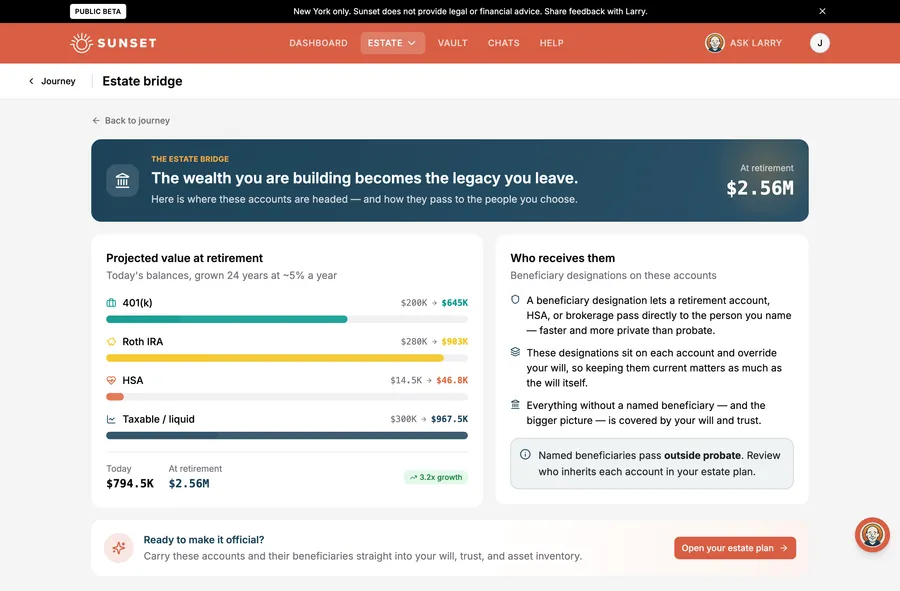
These accounts have a beneficiary designation form on file. Whichever name is on that form is who gets the money when you die—period. Your will cannot override it. Your divorce decree cannot override it. This is why an outdated beneficiary form can undo years of estate planning. You must update the form itself.
Beneficiary designations override your will
If your will says your money goes to your kids but your 401(k) still names your ex-spouse, your ex gets the 401(k). Update beneficiary forms right away after any major life change. Learn the exact assets that bypass your will.
The divorce problem: your ex might still be your beneficiary
Here is what many people do not realize: divorce does NOT automatically remove your ex-spouse from your retirement accounts or life insurance.
Federal law, called ERISA (the Employee Retirement Income Security Act), governs most private-sector employer plans—401(k)s, most private 403(b)s and pensions, and many employer group life plans. (Government and church plans—including many public-school and nonprofit 403(b)s and all governmental 457 plans—are generally outside ERISA and follow state rules instead.) For an ERISA plan, the plan document and beneficiary form control, so a divorce decree alone cannot remove your ex—only a new beneficiary form (or a qualified domestic relations order) filed with the plan can.
The same risk applies to IRAs, which are not ERISA plans at all: state revocation-on-divorce laws vary, and many people wrongly assume the divorce process handles it. Whatever the plan, the safe move is identical—file a new beneficiary form yourself.
What to do immediately after divorce
- Get a copy of your divorce decree or settlement agreement.
- Contact your employer’s HR department or plan administrator (often a company like Fidelity, Vanguard, or Schwab).
- Request a Beneficiary Designation Form.
- Sign and date the form, naming your new beneficiary (or leaving it blank if you want to decide later).
- If the plan requires it (ask), have the form witnessed or notarized.
- File the original with the plan administrator and keep a photocopy.
- Get written confirmation that the change was received and processed.
HSAs have their own divorce rule
HSAs are individual accounts (not ERISA plans), so there is no automatic spousal-consent rule the way there is for a 401(k). Whether a divorce automatically revokes a former spouse’s HSA designation depends on your state and your HSA custodian—some states have revocation-on-divorce laws, many don’t. Don’t rely on any default: update your HSA beneficiary form directly after a divorce or remarriage so the record matches your wishes. (One thing that is uniform: if your spouse is the HSA beneficiary, they inherit it as their own HSA tax-free; a non-spouse beneficiary owes income tax on the full value.)
What to do after marriage
When you marry, check every account, especially if you had assets before the marriage.
The ERISA spousal consent rule
Under ERISA (which governs most private-sector 401(k)s, private 403(b)s, and pensions), a married person’s spouse has automatic rights unless the spouse formally consents in writing to waive them. For a typical 401(k), that means your spouse is entitled to the entire account at your death unless they’ve signed a waiver; a traditional pension instead provides a survivor annuity. Either way, naming someone other than your spouse requires their written consent, usually witnessed by a notary or plan representative. (Governmental and church plans set their own rules and may not follow ERISA here.)
What this means: if you are married and want to name your adult children, a sibling, or a trust as your beneficiary, you must bring your spouse to your HR office or contact your plan administrator and have them sign a beneficiary waiver form. Your spouse’s signature must be notarized or witnessed by the plan representative. A casual conversation is not enough.
IRAs do not have this requirement (outside community property states). You can name anyone as your IRA beneficiary without your spouse’s consent. But once you roll a 401(k) into an IRA, you lose this protection—your spouse can no longer demand their share if you die. This is a real planning consideration and worth discussing with your spouse and a financial advisor or attorney.
When you roll a 401(k) into an IRA
Rolling your 401(k) into an IRA after leaving a job gives you more control over investments and lower fees. But you lose ERISA spousal protections. Your new spouse cannot demand a share of an IRA the way they can with a 401(k). If this matters to you—because you want to guarantee your spouse will be protected—discuss it with a financial advisor before rolling over.
The complete beneficiary checklist
Create a spreadsheet with the following columns: Account Name, Account Type, Institution, Current Beneficiary (Primary), Contingent Beneficiary, Last Updated, and Notes. List every account below.
| Account Type | Details | Action After Marriage or Divorce |
|---|---|---|
| 401(k) or 403(b) | Employer retirement plan; usually ERISA if private-sector (many governmental/church 403(b)s are not) | File a new form with HR. For ERISA plans, spouse must consent in writing to name a non-spouse. |
| IRA (Traditional or Roth) | Individual retirement account; not ERISA governed | Contact custodian (Fidelity, Vanguard, etc.). Spousal consent not required in most states. |
| 457 plan | Deferred-compensation plan; governmental 457s are not ERISA plans (no ERISA spousal-consent rule); nonprofit 457s differ | File a new form with the plan; don’t assume ERISA spousal rights apply—confirm with the plan. |
| HSA | Health Savings Account; individual account, not ERISA (no spousal-consent rule) | Update the beneficiary form directly. Revocation-on-divorce depends on your state and custodian—don’t assume it’s automatic. |
| Employer pension | Defined-benefit plan; private-sector plans ERISA-governed (governmental pensions follow their own rules) | Same as 401(k)—spouse typically has automatic survivor rights. New form with HR, witnessed waiver required if naming non-spouse. |
| Life insurance | Individual or through work; may or may not be ERISA governed | Check policy. If through work and ERISA-governed, spouse consent rules apply. Personal policies generally do not require consent. |
| TOD brokerage account | Brokerage held with Fidelity, Schwab, Vanguard, etc. | Many states auto-revoke ex-spouse’s designation on divorce. Update manually to confirm. Not ERISA governed. |
| POD bank account | Savings or checking account at your bank | Many states auto-revoke ex-spouse on divorce. Update anyway. Not ERISA governed. |
The annual review reminder
Set a calendar reminder every January 1 to review your beneficiary designations. Life changes—job changes, new kids, deaths—can happen. A quick 30-minute review once a year prevents costly mistakes. Use your spreadsheet as your checklist.
After the birth of a child
When a baby arrives, you are likely thinking about nursery colors and sleep schedules, not beneficiary forms. But the first 30 days after birth are the right time to update your beneficiaries. Here is what to prioritize:
- Name your child as a contingent (backup) beneficiary on your 401(k), IRA, and life insurance. If you die while your child is a minor, a custodian (usually a parent or trusted adult) will manage the money until your child reaches adulthood (set by your state, usually 18 or 21).
- Name a guardian in your will for your minor children. Beneficiary designations do not appoint a guardian—only your will does. If you name your child as a beneficiary but do not name a guardian in your will, the court will decide who raises your child.
- Add a contingent beneficiary on life insurance. If you die and your spouse dies soon after (a rare but real scenario), you want your child’s inheritance to go to a trusted person or a UTMA/UGMA account, not to your ex’s parents or a default heir.
- Consider a trust as your IRA or 401(k) beneficiary instead of naming minor children directly. This lets you control when they receive the money (at 25, at 35, at graduation, etc.). For eligible designated beneficiaries (a spouse, a minor child until age 21, someone disabled or chronically ill, or someone not more than 10 years younger than you), a properly drafted trust can preserve stretch payouts. For most adult children and other non-eligible beneficiaries, though, the SECURE Act 10-year rule still applies—the details are complex and worth discussing with an estate attorney.
Name a backup executor
When you name your child as a beneficiary, also name an executor in your will (someone who will manage your estate and make sure money reaches your kids). Do not assume this will happen automatically. Make it explicit.
Beneficiary forms are legal documents—do this right
When you complete a beneficiary form, you are legally binding where your money goes. Small mistakes can cause big problems.
Get the name exactly right
Write the full legal name and Social Security Number (or tax ID) of each beneficiary. Do not use nicknames. If a beneficiary’s name has changed (marriage, divorce, adoption), update your forms to use the current legal name. If a form says “Bob Smith” and your beneficiary legally changed to “Robert J. Smith” and has a new SSN, the plan may have trouble identifying them.
Name both primary and contingent beneficiaries
A primary beneficiary is first in line. A contingent (or secondary) beneficiary receives the money if the primary has died. It’s worth naming a contingent, even if it feels unlikely that the primary will predecease you. If you don’t and the primary dies before you, the money is distributed under the plan’s default rules—often to your estate, which can mean probate delays.
Example
- Primary: “Jane Doe, SSN 123-45-6789”
- Contingent: “John Doe, SSN 987-65-4321”
Update TOD and POD accounts with the same care
Transfer-on-Death (TOD) brokerage accounts and Payable-on-Death (POD) bank accounts are not subject to probate, but the beneficiary form is still a legal document. Be precise with names and SSNs. If you name the wrong person or misspell a name, the institution may distribute the money to your estate instead, forcing probate.
When a beneficiary dies before you
If your named beneficiary dies before you, the money does not go to their heirs automatically. It goes to your contingent beneficiary if you named one. If you did not name a contingent, the money is distributed according to the plan’s rules (usually to your estate, which triggers probate and delays). Update your forms within 30 days of a beneficiary’s death.
What about life insurance, TOD, and POD if you’re unmarried?
If you are single or have no spouse:
- Life insurance, TOD, and POD accounts do NOT require spousal consent. You can name anyone—a child, parent, sibling, friend, or charity.
- IRAs also do not require spousal consent. Name whoever you want.
- 401(k)s and pensions are different. Even if you have no spouse now, if you marry later, your new spouse will gain automatic ERISA rights unless you both agree to waive them in writing.
The risk: if you marry tomorrow, name your new spouse as your 401(k) beneficiary, and then die before you update your will, your new spouse could inherit both the 401(k) and a large portion of your estate under state intestacy law—even if that was not your intent.
New York state note: no portability, a high cliff
If you are a New York resident and your estate exceeds $7,350,000 (2026 NY exemption), you face a harsh cliff: if your estate is valued at more than about 5 percent over the exemption (roughly $7.7 million or more), you lose the ENTIRE exemption and owe NY estate tax on the full value. New York does not allow portability—the unused exemption of a deceased spouse cannot be transferred to you. This is a specific reason to update your will and beneficiary forms every two to three years if your estate is large. Learn more about the NY estate tax cliff.
Bringing it together: update beneficiaries AND your will
Here is the takeaway: your will and your beneficiary designations are two separate legal documents that must work together. Your will cannot override beneficiary forms. So after any major life change—marriage, divorce, birth, death—you must update both.
The best approach: schedule one meeting with an estate attorney or financial advisor (or both). Bring your beneficiary forms and your will. Go through them together and update both at the same time. This ensures your money goes where you want it to and that your wishes are clear and enforceable.
Once you have updated your beneficiary forms and will, add your Money Roadmap details to the Money Roadmap tool in Sunset. Link each account, name the beneficiary, and set a yearly calendar reminder to review. This gives you confidence that your family is protected and that if something happens to you, the right people know where your money is and how to access it.
Your estate plan is not complete until both your beneficiary forms and your will are current. Make it happen this week.
Sources
- 1.Retirement Topics — Divorce | Internal Revenue Service(opens in new tab)(irs.gov)
- 2.Fixing Common Plan Mistakes — Failure to Obtain Spousal Consent | IRS(opens in new tab)(irs.gov)
- 3.Do Surviving Spouses Have Rights to a 401(k) or an IRA? | ElderLaw Answers(opens in new tab)(elderlawanswers.com)
- 4.Beneficiary Designations in Estate Planning: Complete Guide (2026) | Opelon(opens in new tab)(opelon.com)
- 5.Transfer on Death (TOD) and Payable on Death (POD) Accounts | LegalClarity(opens in new tab)(legalclarity.org)
- 6.HSA Beneficiary Rules | SmartAsset(opens in new tab)(smartasset.com)
- 7.How To Update Your Beneficiaries After Major Life Events | Chase(opens in new tab)(chase.com)
- 8.Beneficiary Designations: Getting the Right Assets to the Right People | Connor & Sullivan(opens in new tab)(connorsandsullivan.com)