New York
New York Estate Tax Cliff: How a $7M+ Estate Can Lose Its Entire Exemption
New York's 105% estate tax cliff means estates over $7.7M lose their entire exemption and face taxes from dollar one. NY has no portability. Here's how to plan.
If you live in New York and have a net worth above $7 million, your estate faces a punishing tax rule that most high-net-worth Americans outside the state never encounter: the 105% cliff. Cross that threshold, and New York doesn’t just tax the excess—it strips away your entire exemption and taxes every dollar of your estate, starting from one.
Unlike the federal system (which has no cliff and allows married couples to combine exemptions), New York’s estate tax is a state-only problem that demands separate planning. Here is how the cliff works, why it matters to your will and estate plan, and what moves you can make right now.
The New York estate tax cliff: How you can lose it all
For 2026, New York allows a $7,350,000 estate tax exemption per person (2026). In plain English: if your estate is worth $7.35 million or less when you die, you owe zero New York estate tax to the state.
But the cliff kicks in at 105% of that exemption—roughly $7,717,500. If your estate exceeds this amount by even a dollar, New York applies estate tax to your full taxable estate, with no exemption at all.
This is not the same as federal tax, which has a $15,000,000 (2026) exemption and no cliff. Under federal law, if your estate is $10 million, you only owe tax on $500,000 of the excess. Under New York law, if your estate is $10 million and you die as a resident, you owe tax on the entire $10 million.
The danger zone: why $367,500 costs so much
Between $7.35 million and about $7,717,500 sits a narrow but treacherous band—the phase-out zone. Once your estate crosses the $7.35 million exemption, New York begins shrinking your exemption credit; by the time the estate reaches 105% of the exemption (about $7,717,500), the credit disappears entirely and your whole taxable estate is taxed from the first dollar. An estate of $7.4 million is not yet “over the cliff”—it sits in the phase-out zone, where the credit is reduced (not gone) and each dollar over the exemption is taxed at an extraordinarily high effective marginal rate.
A New York estate planner might warn you: inside that phase-out band, even a modest overage can trigger a disproportionately large tax bill, because your exemption is melting away as the estate grows. An estate at or below $7.35 million owes no New York estate tax; once the estate tops about $7,717,500, the exemption is gone completely and the full value is taxed at graduated rates of 3.06%–16%. That hairline math is why high-net-worth New Yorkers plan aggressively to stay below the exemption.
This is vastly different from federal estate tax. The federal government allows portability: if one spouse dies in 2026 and does not use their full $15 million exemption, the surviving spouse can claim the unused portion. This doubles the effective exemption for couples to $30 million with zero planning friction.
New York allows no portability.
New York has no portability. Period.
Unlike federal law, New York does not allow a surviving spouse to inherit or use their deceased spouse’s unused estate tax exemption. If your spouse dies in 2026 with a $4 million estate and a $7.35 million exemption, your spouse wastes $3.35 million of that exemption. When you die, you only get your own $7.35 million exemption. That unused exemption is gone forever.
Why federal and state planning are not the same
Many high-net-worth couples assume that if they have a solid federal estate plan (trusts, portability elections, beneficiary designations), they are protected from New York taxes. They are wrong.
Your federal estate might clear the $15 million threshold easily. But your New York estate only has a $7.35 million cushion—less than half the federal exemption. A $10 million estate, for instance, passes federal muster with no federal tax but triggers a full New York estate tax bill on the entire $10 million.
The two systems operate independently. You need a plan for each.
| Factor | Federal Estate Tax | New York Estate Tax |
|---|---|---|
| 2026 exemption | $15M per person | $7.35M per person |
| Couples’ total exemption | $30M (with portability) | $14.7M (no portability) |
| Cliff | None | 105% cliff loses entire exemption |
| Rate | 40% on excess | 3.06%–16% graduated |
| Portability | Allowed (spouse inherits unused exemption) | Not allowed |
Planning levers: how to protect your estate from the cliff
1. Credit Shelter Trusts (Bypass Trusts)
For married couples, the most common solution is a credit shelter trust (also called a bypass trust). Here is how it works:
When the first spouse dies, their assets—up to the full $7.35 million New York exemption—fund a trust rather than pass directly to the surviving spouse. The surviving spouse receives income (and can access principal for emergencies), but the principal remains in the trust and outside the surviving spouse’s taxable estate.
When the surviving spouse later dies, that trust principal is not taxed by New York because it remains in the trust and outside the surviving spouse’s taxable estate, even if it has grown significantly.
Example: Marcus and Sarah live in New York and have a $14 million net worth. Marcus dies in 2026. His will directs $7.35 million (his exemption) into a bypass trust for Sarah’s benefit. The remaining $6.65 million passes to Sarah outright. When Sarah dies years later, only her own $7.35 million exemption applies, but her estate is now larger. Without the bypass trust, both Marcus’ and Sarah’s exemptions would have been wasted, and the second-to-die tax bill would be catastrophic.
A bypass trust captures both spouses' exemptions
Credit shelter trusts are the standard solution for married couples in New York. Each spouse’s exemption is used once, at the first death, sheltering the largest possible amount from state tax. The surviving spouse still has full economic benefit of that trust; it simply remains outside their taxable estate.
2. Lifetime Gifting: The Annual Exclusion
You can gift $19,000 per recipient, per year (2026), without using any of your $7.35 million exemption. Married couples can combine to gift $38,000 per recipient per year.
Over a decade, a married couple can give away $380,000 per recipient with zero estate tax impact—simply by making annual gifts to children, grandchildren, or trusts.
Example: David and Carol have three adult children and wish to reduce their $12 million estate. Starting this year, they gift $38,000 per child per year ($114,000 total). Over 10 years, they give away $1.14 million—money that is out of their taxable estate and not subject to the cliff. Their children benefit immediately, and David and Carol have shrunk their combined estate closer to safety.
3. Irrevocable Trusts and the 3-Year Clawback Rule
New York (unlike the federal government) has a three-year “add-back”: taxable gifts a New York resident makes within three years of death are pulled back into the New York taxable estate (a rule the legislature has extended to deaths before 2032). The reliable ways around it are time and the annual exclusion—not a particular kind of trust.
A completed gift made more than three years before death falls outside the add-back, whether or not a trust is involved. And annual-exclusion gifts (up to $19,000 per recipient in 2026) are not “taxable gifts” under the tax code, so they generally are not added back at all. Do not assume a gift escapes the add-back just because it went into an irrevocable trust: a taxable gift made inside the three-year window is generally still added back.
Irrevocable trusts and Spousal Lifetime Access Trusts (SLATs) remain powerful New York tools. A SLAT is an irrevocable trust funded with one spouse’s assets, naming the other spouse as a discretionary beneficiary—moving assets out of the taxable estate while the beneficiary spouse retains access if needed. But the three-year add-back applies to the funding gift like any other, so timing (and whether the transfer is a taxable gift) is what determines the outcome. Because these mechanics are nuanced and the law has been changing, work with a New York estate attorney or CPA before relying on any of them.
The 3-year add-back catches most deathbed gifts
If you make a large taxable gift and die within three years, New York pulls that gift back into your taxable estate—whether it went to a person or an irrevocable trust. Annual-exclusion gifts (not “taxable gifts”) are the main thing that stays out, and any completed gift you survive by more than three years is safe. This is why lifetime planning and timing matter far more in New York than in low-tax states.
Connecting the cliff to your will and estate plan
The New York estate tax cliff is not a problem you can solve with a will alone. Your will controls which assets your beneficiaries receive, but it does not prevent the tax.
Instead, you need:
- A testamentary bypass trust (created in your will at death, for married couples) or a living trust with bypass provisions already drafted
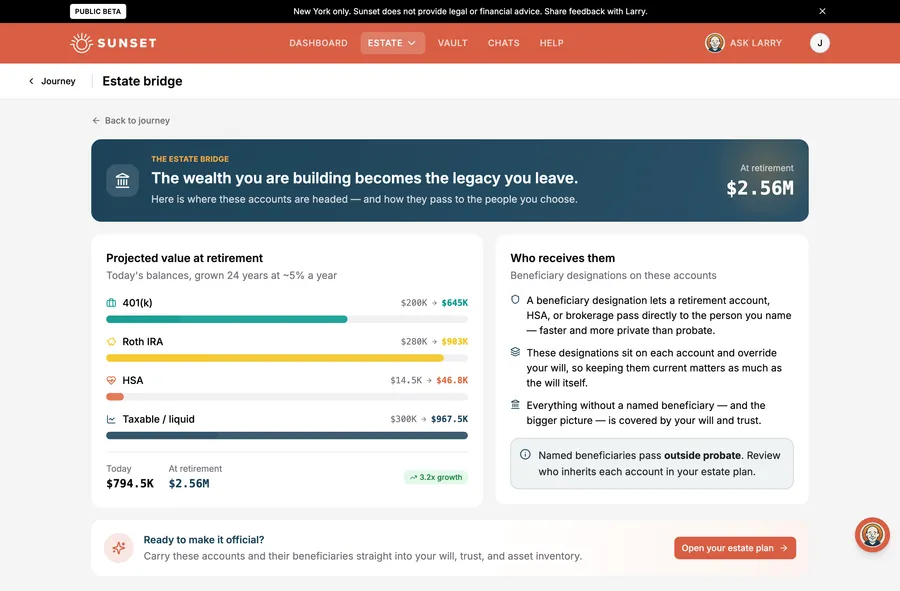
- Explicit beneficiary designations on retirement accounts and life insurance (these pass outside probate and your will; see how beneficiary designations override your will)
- A gifting strategy that uses your $19,000 annual exclusion and strategic irrevocable trusts
- An understanding of which assets go where, using a complete money-to-heirs asset map
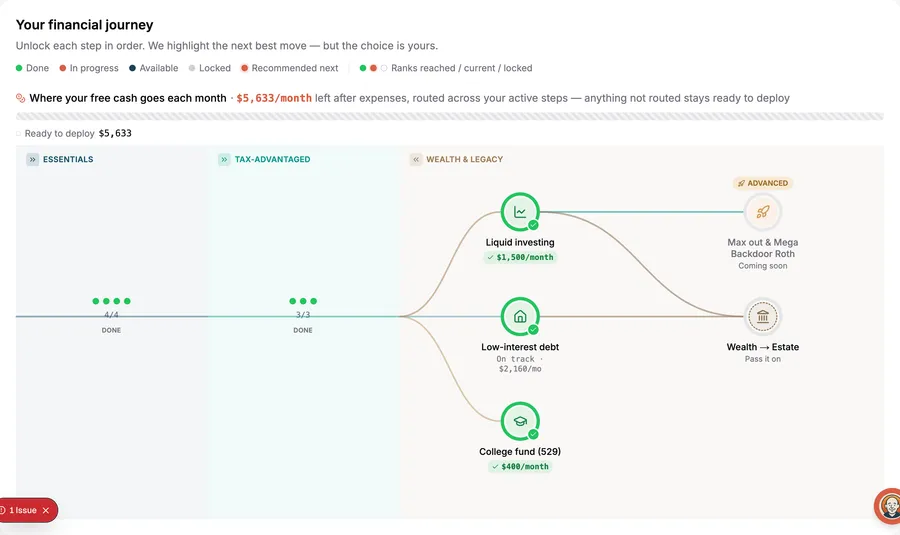
Your Money Roadmap helps you understand every asset and its tax treatment. Once you know where your money sits, you can build the right estate structure.
Why now matters: the federal–state gap is here to stay
In 2026, the federal estate tax exemption is $15 million per person, made permanent and inflation-indexed by the 2025 tax law. New York’s exemption, by contrast, sits at just $7.35 million—less than half the federal amount—and New York sets it independently of the federal figure.
That gap is the whole problem: a New York estate can be completely safe from federal tax yet fully exposed to the state’s cliff. Gifting and irrevocable trusts are permanent tax-reduction tools, and the three-year clawback rule rewards acting sooner rather than later.
High-net-worth New Yorkers sitting on estates over $7 million should not wait. The cliff is real, the stakes are high, and every year you delay is 12 fewer months of clawback safety.
Your money roadmap ends in your estate plan. The Sunset Money Roadmap walks you through the assets you have, the tax rules that govern them, and the trusts and beneficiary structures that make sense for New York. Once you know your numbers, you can work with a New York estate planning attorney to build the bypass trusts, gifting plan, and irrevocable structures that actually save money at death.
Sources
- 1.New York Estate Tax Exemption 2026: $7.35M and the 105% Cliff(opens in new tab)(tax.ny.gov)
- 2.IRS 2026 Estate and Gift Tax Exemption Amounts(opens in new tab)(irs.gov)
- 3.New York Estate Tax Exemption 2026 & the Tax Cliff Explained(opens in new tab)(ejrosenlaw.com)
- 4.Understanding New York's 105% Estate Tax Cliff(opens in new tab)(nywillsandestates.com)
- 5.New York Estate Planning Strategies 2026: Credit Shelter Trusts and Gifting(opens in new tab)(mcdermottlaw.com)
- 6.Avoiding the New York Estate Tax Cliff: Federal vs. State Planning(opens in new tab)(greenbushfinancial.com)
- 7.Planning for 2026: Trusts and Estates Tax Updates(opens in new tab)(seyfarth.com)
- 8.New York Estate Tax and the No-Portability Rule(opens in new tab)(ceritypartners.com)