Account Guides
The HSA Inheritance Tax Trap: Why a Non-Spouse Heir Gets a Tax Bill (and How to Avoid It)
A non-spouse HSA beneficiary pays income tax on the full balance in the year of death. Spouse beneficiaries inherit tax-free. Learn the trap and how to plan around it.
When you die, your HSA beneficiary designation determines whether your account passes tax-free or triggers an immediate income tax bill for your heir. A spouse keeps the HSA and its tax-free status; a non-spouse beneficiary must report the entire account balance as taxable income in the year of death. Naming your estate instead of a person makes it even worse—the tax bill lands on your final tax return.
This trap catches many estate planners off guard because HSA rules are different from retirement accounts. But if you have a six-figure HSA balance or non-spouse heirs, the wrong beneficiary choice can cost your family tens of thousands in taxes.
How HSA inheritance works: the spouse advantage
If your spouse is your HSA beneficiary, the transfer is completely tax-free. Your HSA simply becomes their HSA. They can continue to withdraw funds for their own qualified medical expenses tax-free, and if they remain enrolled in an HDHP (high-deductible health plan), they can keep contributing. Your spouse has full control—the account never loses its HSA status.
This is the only scenario where an HSA passes without any immediate tax consequence. For many married people, that tax-free treatment makes a spouse the natural HSA beneficiary—though your overall plan and goals still matter.
The non-spouse beneficiary trap: full FMV becomes taxable income
Here is where the trap springs. If your non-spouse beneficiary (a child, sibling, parent, or friend) inherits your HSA, the entire fair market value of the account on the date of your death is included as ordinary taxable income to them in that same tax year.
The HSA ceases to be an HSA. Your heir gets no special tax treatment—they owe federal income tax on the full balance, plus their state income tax, in the year you die.
Let us work through an example. Suppose you have a $75,000 HSA and name your adult son as beneficiary. You pass away in 2026. Your son must report $75,000 as taxable income on his tax return for that year. If his other income puts him in the 32% federal tax bracket (combined with state, possibly over 40%), he could owe $24,000 to $30,000 in taxes—money that comes out of his own pocket, not the HSA.
Worse: if your beneficiary is your estate (because you never filled out a beneficiary form, or you explicitly wrote “payable to my estate”), the entire HSA balance gets included on your final individual tax return. This can push your estate into a very high tax bracket and reduce the assets your heirs actually inherit.
The one-year medical-bill offset: reducing the tax, but only if you plan
There is one exception that can reduce a non-spouse heir’s tax bill. If your beneficiary uses HSA funds to pay any unpaid medical bills or expenses that you incurred before you died, and they pay those bills within one year of your death, they can reduce their taxable income by that amount.
Here is the catch: this only works if you actually have unpaid medical bills. A beneficiary cannot use the HSA to retroactively pay old medical expenses that were already paid out of pocket. The bills must belong to you, the deceased account holder, and they must be documented.
Maximize the offset by planning ahead
If you know you have unpaid medical bills at the end of your life—co-pays, deductibles, dental work, glasses, hearing aids—make sure your beneficiary knows about them. Leave a list with your will or power of attorney. The offset can save your heir thousands in taxes.
Estate as beneficiary: the worst-case scenario
If you fail to name a beneficiary, or if you explicitly name “my estate,” here is what happens: the HSA’s fair market value is included in your gross income on your final individual tax return, not on a beneficiary’s return. This is almost always the worst tax outcome.
Why? Because your final tax return may combine years of income with a massive one-time HSA distribution, creating an unusually high tax bill that exhausts assets before they reach your heirs. Your estate then pays that tax, reducing the inheritance.
Naming your estate is usually the worst HSA tax outcome
When the estate is the beneficiary, the HSA’s value lands on the decedent’s final income-tax return, often at the highest rates. Naming a person instead generally produces a better tax result, because the income is reported by that beneficiary. If you have no spouse, it’s worth weighing your options with a tax professional rather than leaving the HSA to default to your estate.
HSA inheritance planning for non-spouse scenarios
If you have no spouse, or if you want to name a non-spouse beneficiary, there are strategies to soften the tax blow:
Name multiple beneficiaries. Split the HSA among two or three children or heirs. Each beneficiary reports only their proportional share as taxable income, which may push each of them into a lower tax bracket. A $75,000 HSA split three ways ($25,000 each) may result in lower combined taxes than one heir owing on the full $75,000.
A trust adds control, not tax deferral. Some HSA custodians allow a trust to be named as beneficiary. Be clear on what this does and doesn’t do: a trust can give you control over how the money is used after you’re gone, but it does not spread out the tax. Because a non-spouse beneficiary (including a trust) ends the HSA at your death, the full value is taxed as income in the year you die—there’s no IRA-like stretch. Consult an estate attorney and CPA to see whether the control is worth it in your situation.
Use the HSA first during your lifetime. The less money in your HSA when you die, the smaller the tax bill for your heir. If you are retired and have other funds, consider withdrawing from your HSA for qualified medical expenses and letting other savings grow. This is especially smart if you expect to have significant out-of-pocket medical costs in your final years.
Plan around life changes. If you get married, divorce, or have a child, update your beneficiary immediately. Many people forget to change HSA beneficiaries after marriage or divorce, which can result in an ex-spouse inheriting your account.
Connect HSA planning to your broader estate strategy
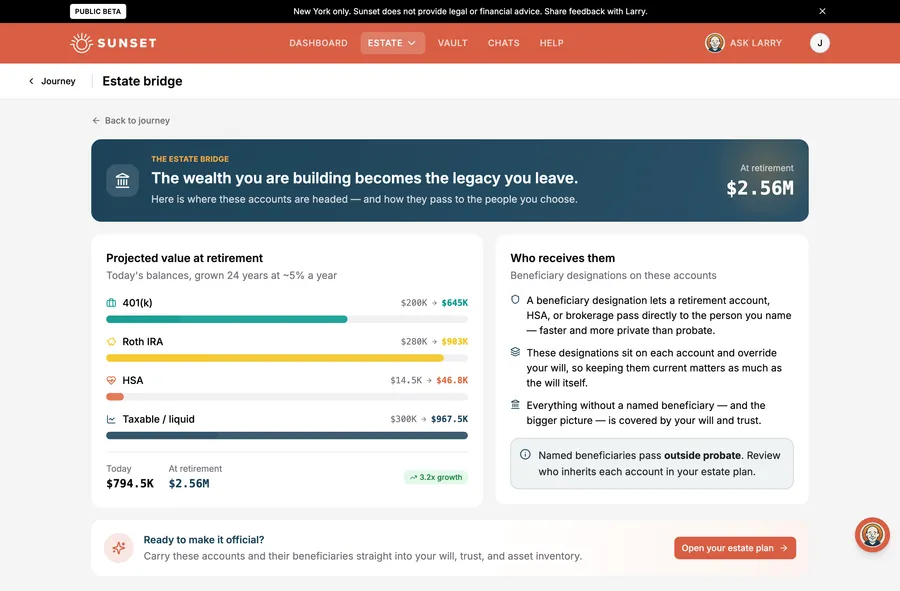
HSA beneficiary choices sit at the intersection of health care planning and estate planning—two things many people keep separate. But your HSA is an asset, and like your 401(k), IRA, and life insurance, its beneficiary designation overrides your will.
This is why HSA planning must be part of your complete picture. When you map all your assets and decide where each one goes, your HSA should be on that map. A spouse-based plan, a multi-generational plan, a trust-based plan—each changes the optimal HSA beneficiary choice.
New York residents face an added layer: the state estate tax cliff at $7.35 million means that if your estate is large, HSA planning might need to coordinate with trust strategies and exemption planning. Even a smaller HSA can tip you over a threshold if you have significant other assets.
The broader lesson is this: HSAs are powerful retirement-savings tools when used for health care. But if they grow large, or if you have complicated heirs, they demand intentional beneficiary planning. The right choice now prevents a tax surprise for your family later.
Start with your Money Roadmap, which guides you through every asset and decision. Then connect that roadmap to your estate plan, where beneficiary designations matter most.
Sources
- 1.IRS Health Savings Accounts (HSAs) — Death and Beneficiaries(opens in new tab)(irs.gov)
- 2.HSA Beneficiary Rules — SmartAsset(opens in new tab)(smartasset.com)
- 3.Inherited Health Savings Accounts — HSA for America(opens in new tab)(hsaforamerica.com)
- 4.What Happens to an HSA Upon Death — Thomson Reuters Tax(opens in new tab)(tax.thomsonreuters.com)
- 5.Designating an HSA Beneficiary: What to Know — GoodRx(opens in new tab)(goodrx.com)
- 6.NY Estate Tax 2026 — Bartal Law(opens in new tab)(bartallaw.com)
- 7.New York Estate Tax — NY Department of Taxation and Finance(opens in new tab)(tax.ny.gov)
- 8.HSA Beneficiary Rules FAQ (2026) — HSA Trackr(opens in new tab)(hsatrackr.com)