Wealth & Will
Beneficiary Designations vs. Your Will: Which One Actually Controls Your Money?
Beneficiary designations almost always override your will. Learn which assets pass by designation, the ex-spouse trap, and how to keep your will and forms in sync.
Beneficiary designations almost always win—institutions pay the form on file, not the will. This distinction is the single most important thing you can understand about wealth transfer, yet most people discover it only after they die, when it is too late to fix.
The core rule: designation beats will, every time
Your will is instructions for your executor on how to distribute assets that don’t have a named owner or recipient. A beneficiary designation is a legal contract between you and your financial institution. When you die, the institution is required to transfer the asset to whoever you named on the form. Your will cannot override it.
Here is why this matters: if you updated your will after a divorce or after your kids were born, you probably assumed those assets would follow your new will. They won’t—not unless you also updated the beneficiary forms.
The pattern is consistent. For ERISA-covered plans (most private-sector 401(k)s and similar employer plans), the administrator generally must pay the named beneficiary on the form. For other accounts—IRAs, individual life insurance, POD/TOD accounts—the institution likewise follows the beneficiary contract rather than the will, though state revocation-on-divorce laws can affect some of them. Across the board, the institution follows the form on file, not your will.
Which assets are controlled by beneficiary designation
Some of your most valuable assets pass by designation, not by will. This is critical to understand because it means your will does not actually control them.
| Asset Type | Passes By Designation | Passes Through Will |
|---|---|---|
| 401(k), 403(b), 457, IRA | Yes | No |
| Life insurance policy | Yes | No |
| Annuity | Yes | No |
| Health Savings Account (HSA) | Yes | No |
| Transfer-on-Death (TOD) brokerage account | Yes | No |
| Payable-on-Death (POD) bank account | Yes | No |
| Savings bonds (Series I, EE) | Yes | No |
| Your house (if not titled as TOD deed) | No | Yes |
| Your car | No | Yes |
| Personal property (jewelry, art, furniture) | No | Yes |
| Checking account (without POD) | No | Yes |
The top half of that table represents the bulk of your wealth for most people. A Money Roadmap forces you to map every asset, designate beneficiaries for each one, and then cross-check them against your will. Most people never do this.
Your money and your will control different assets—and that is your biggest estate-planning risk
Retirement accounts, HSAs, life insurance, and transfer-on-death accounts pass to whoever you named as beneficiary. Your will has zero authority over them. See exactly which asset goes where. The only way to guarantee your money goes where you intend is to keep your beneficiary forms in sync with your will and update both after any major life event.
The ex-spouse trap: a real-world example
You married and named your spouse as beneficiary on your 401(k) and life insurance policy. You divorced five years later and updated your will to leave everything to your kids. You forgot about the beneficiary forms—they are buried in your employer’s website and in a filing cabinet at home.
You die.
Your employer’s 401(k) administrator looks at the form on file. It says your ex-spouse is the beneficiary. By law, the administrator must pay your ex-spouse. Your will said your kids inherit, but the will does not control a 401(k). Your ex-spouse receives the money. Your kids get nothing from that account.
This is not hypothetical. Courts rule on this scenario regularly. In a 2026 case, Packaging Corp. of America Thrift Plan for Hourly Emps. v. Langdon, a federal court held that the deceased’s ex-spouse was entitled to retirement assets because the participant failed to properly update the beneficiary designation form before death. The will could not fix the mistake.
ERISA (the Employee Retirement Income Security Act) is federal law that governs most private-sector employer plans—401(k)s, most private 403(b)s, and many group life insurance policies. (Government and church plans, and many public-school and nonprofit 403(b)s, are generally outside ERISA and follow state rules instead.) For an ERISA plan, the administrator must follow the beneficiary form on file, even if state law would otherwise revoke an ex-spouse’s designation on divorce. In other words, for those plans federal law overrides state law.
For individual life insurance policies (not through an employer), some states have adopted “revocation on divorce” statutes that automatically remove an ex-spouse’s designation. But even then, only if you did not elect to keep them. Many people never know this. And ERISA employer plans do not get this protection—you must update the form yourself.
After any divorce, update beneficiary designations on the same day you finalize your will
Do not assume your ex-spouse’s name will disappear. ERISA rules and state law vary—and most employers and insurers follow the form on file. Contact your HR department, insurance company, and any brokerage the day your divorce is final. Request current beneficiary forms, update them, and keep a copy. Do the same after any marriage, remarriage, or significant life event.
New York and probate avoidance: why designations matter here
New York allows beneficiary designations on bank accounts (payable-on-death) and securities accounts (transfer-on-death) to bypass probate entirely. This is powerful. When you set up a POD or TOD designation, you remain the sole owner of the account during your lifetime. You can spend the money, close it, or change the beneficiary any time you want. No one has to ask permission.
When you die, your beneficiary simply presents your death certificate to the financial institution and proves their identity. The money transfers directly to them within days or weeks. No probate, no court, no attorney, no delays, no public record.
This is why beneficiary designations are one of the best probate-avoidance tools in New York.
However, New York does not allow portability of the state estate-tax exemption. If your estate exceeds the New York basic exclusion (currently $7,350,000 in 2026), the state imposes estate tax. And New York has a cruel “cliff” rule: estates that exceed about 105% of the exemption lose the entire exemption and owe tax on the full estate value. A beneficiary designation cannot protect you from state estate tax—only careful tax planning and the right will and trust structure can.
Use beneficiary designations for probate avoidance; use your will and trust for tax planning
Beneficiary designations keep assets out of probate and away from court delays. But they don’t shield you from NY estate tax. You need both: designations on the accounts that can have them (retirement, insurance, POD/TOD), and a will or revocable living trust that names an executor and structures the remaining assets. Sunset’s Money Roadmap helps you plan both layers.
How to audit and update your beneficiary designations
Start with a list of every account that can have a beneficiary:
- Your employer 401(k), 403(b), or 457 plan
- Every IRA (traditional, Roth, SEP, or Solo) at every brokerage
- Life insurance (employer-sponsored and individual policies)
- Your HSA at work or via your insurer
- Every bank checking, savings, and money-market account
- Every brokerage account (investment, TOD securities account)
- Any annuities, pensions, or deferred-compensation plans
For each one, log into the account or contact the institution directly and request your current beneficiary form. Write down the exact name, relationship, and percentage for each person listed. Then cross-check it against your will and your intentions.
If any form lists an ex-spouse, a deceased person, or the wrong person, update it immediately. Most institutions allow you to change beneficiaries online or via form. Request a new form, complete it, have it witnessed or notarized if required, and submit it. Ask for written confirmation. Keep a copy.
Do this after every major life event: marriage, divorce, remarriage, birth of a child, significant inheritance, or change in your financial situation.
Beneficiary designations and your overall estate plan
Beneficiary designations are not estate planning by themselves—they are only one piece. A comprehensive plan requires a will that names an executor, a healthcare proxy, and a power of attorney. It may also include a revocable living trust to hold assets, a letter of intent for personal property, and tax-planning structures for larger estates.
But here is the critical insight: your will and your beneficiary designations must tell the same story. If your will says your kids inherit everything but your IRA and 401(k) name your ex-spouse, your estate is in conflict. Your heirs will suffer delays, confusion, and possibly litigation to sort out who gets what.
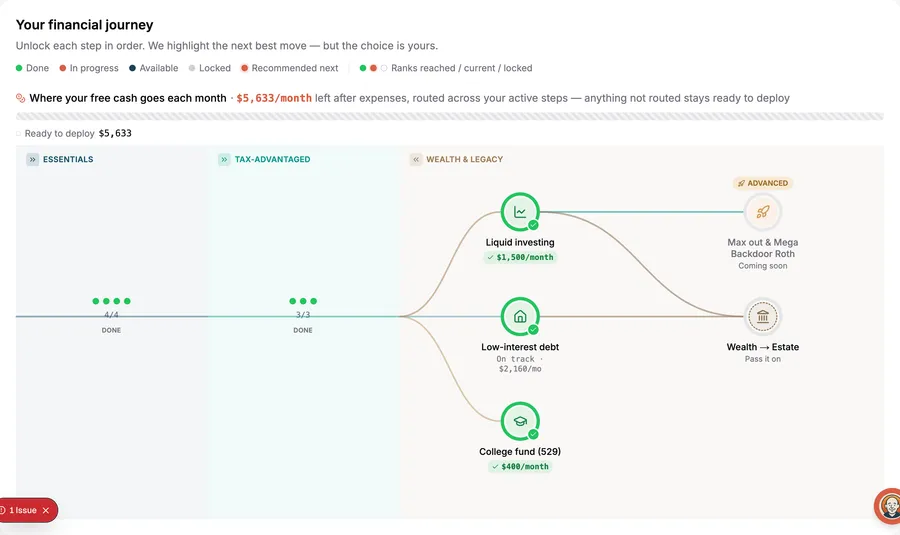
The Money Roadmap is designed to walk you through this alignment. It forces you to map every dollar, name every beneficiary, and then cross-check it all against your will and trust. That is the wedge between personal finance and estate planning—and it is exactly where Sunset helps you prevent disaster.
Keep your plan current and coordinated
The estate plans that fail are not the ones with bad documents. They are the ones that never get reviewed. Life changes. You get married, have kids, get divorced, inherit money, lose a job, start a business. Each change reshuffles your priorities. Your beneficiary forms and your will need to move with you.
Set a calendar reminder to review your designations every year. After any major life event, do it immediately. If you have not updated your beneficiary forms in more than three years, assume they are wrong and fix them. The cost of making a phone call or filling out a form is zero. The cost of leaving money to the wrong person or starting probate litigation to undo a stale designation can be tens of thousands of dollars.
Your beneficiary designations are not just paperwork. They are the primary vehicle through which your wealth passes to the next generation. Treat them with the same care and attention you give to your will.
Sources
- 1.IRS Publication 590-B: Distributions from Individual Retirement Arrangements (IRAs)(opens in new tab)(irs.gov)
- 2.IRS Retirement Topics: Beneficiary(opens in new tab)(irs.gov)
- 3.Beneficiary Designations Override Your Estate Plan – Catalyst Law, LLC(opens in new tab)(catalystlawllc.com)
- 4.Do Beneficiary Designations Override a Will in New York? – Regina Kiperman, Esq., RK Law PC(opens in new tab)(rklawny.com)
- 5.How Beneficiary Designations Override Your Will – Jones Gregg Creehan & Gerace(opens in new tab)(jgcg.com)
- 6.Does a Will Override a Beneficiary Designation? – Edelman Financial Engines(opens in new tab)(edelmanfinancialengines.com)
- 7.Ex-Spouse Does Not Mean Ex Beneficiary – Frigon & Beversluis Law PLLC(opens in new tab)(bjflaw.com)
- 8.How to Avoid Probate in New York – Regina Kiperman, Esq., RK Law PC(opens in new tab)(rklawny.com)