Money Roadmap
How Much Emergency Fund Do You Actually Need? The 3-6 Month Rule, With NYC Numbers
Build the right emergency fund size: 3-6 months of essential expenses (9-12 if self-employed). Learn where to hold it and how it protects your estate plan.
You should aim for 3 to 6 months of essential expenses in an emergency fund—a liquid, separate savings account that keeps you from raiding retirement accounts or going into debt when an unexpected crisis hits. If you are self-employed, have variable income, or are your household’s only earner, build toward 9 to 12 months instead. Start with a $1,000 starter fund while you pay off high-interest credit card debt, then build from there.
The 3-6 Month Rule: What It Really Means
The 3-6 month emergency fund rule is about essential expenses, not your total spending. Essential expenses are rent or mortgage, utilities, groceries, insurance premiums, transportation, and minimum debt payments. It does not include dining out, gym memberships, vacation funds, or streaming services.
This distinction matters because it keeps the target realistic. If you spend $5,000 a month total but only $3,500 is truly essential, your emergency fund target is 3-6 months of $3,500, not $5,000. That is $10,500 to $21,000, not $15,000 to $30,000.
According to the Federal Reserve’s 2025 Economic Well-Being survey, 55 percent of U.S. adults said they had set aside money for three months of expenses in an emergency fund. That also means 45 percent do not. If you are in that 45 percent, start now.
The NYC Angle: What 3-6 Months Actually Costs
New York City living costs are about 75 percent higher than the U.S. average. If you rent a one-bedroom apartment, your monthly budget breaks down roughly like this:
| Expense | Monthly Cost |
|---|---|
| Rent (1-bedroom) | $4,500 |
| Utilities | $180 |
| Groceries | $600 |
| Subway pass | $132 |
| Insurance (health, renter’s, auto) | $400 |
| Minimum debt payments | $200 |
| Total essential expenses | $6,012 |
Three months of essential expenses in NYC is $18,036. Six months is $36,072. That feels large, but it is exactly the point: in a high-cost city, your safety net must be proportionally larger. If you live outside NYC, your essential-expense calculation will be lower, and so will your emergency fund target.
An emergency fund protects your estate plan, not just your job
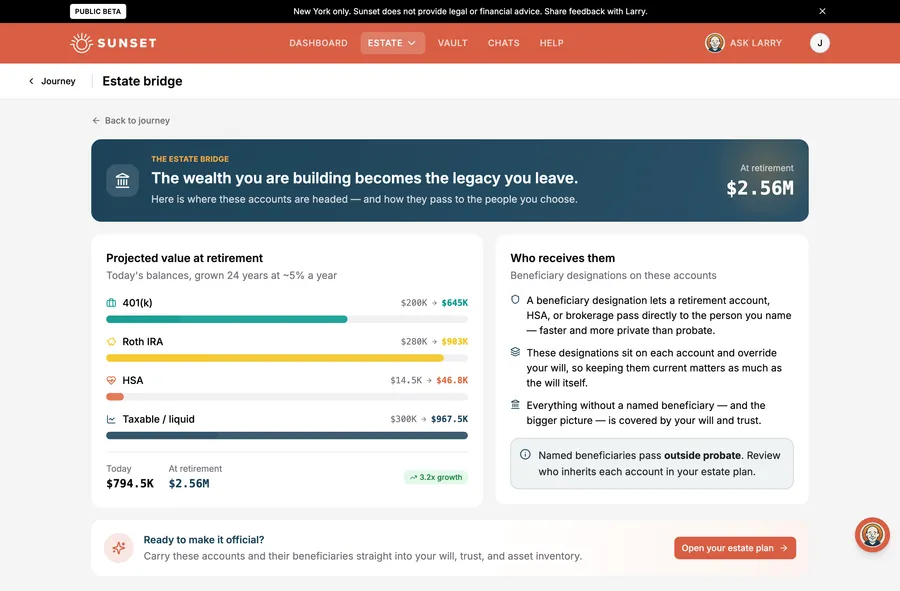
A liquid emergency fund keeps your heirs from having to drain your retirement accounts or sell your home in a crisis. It is why the Money Roadmap starts here. If your family has to pull money out of an inherited IRA or 401(k) to cover a shortfall, those withdrawals are taxed as ordinary income (death-beneficiary distributions avoid the 10% early-withdrawal penalty, but the income tax still applies)—so a gap can mean your heirs get a tax bill instead of a clean inheritance. See exactly which account type goes where in your estate plan.
Why Your Situation Changes the Number
The 3-6 month rule is a guideline, not a law. Here is how to adjust for your life:
Dual-income household, both jobs stable? Three to four months is usually enough. If one person loses a job, the other’s income keeps essentials covered while you search.
Single earner, variable income, or self-employed? Target 9 to 12 months. A freelancer with feast-or-famine months needs a thicker cushion. A salaried single parent has no backup income if they are laid off.
Early retirement, gig work, or volatile industry (tech, construction)? Aim for 12+ months. The job market in your field may move slowly, and you do not want to sell investments during a market downturn.
Recent graduate or living paycheck to paycheck? Start with $1,000—that is enough to cover a car repair, dental emergency, or brief job gap without going into debt. Once high-interest credit card debt is gone, build to 3-6 months.
The debt versus emergency fund tension
Conventional wisdom says: build a small emergency fund first ($1,000), then attack high-interest debt, then build to 3-6 months. This works because an unexpected expense can derail your entire payoff plan if you have to put it on the credit card again. After high-interest debt is eliminated, redirect that payment toward your full emergency fund.
Where to Keep Your Emergency Fund
Do not put your emergency fund in a checking account, regular savings account, CD, stock brokerage, or retirement account. Each choice sabotages the purpose.
High-Yield Savings Account (HYSA): This is the gold standard. As of mid-2026, top-tier online HYSAs earn roughly 4-5% APY—far better than the well-under-1% national average on an ordinary savings account. Your money grows while staying instantly accessible, and you can usually move it to checking within 1-3 business days. Bank rates change constantly, so compare current APYs on a site like Bankrate or NerdWallet before opening one.
Money Market Account: Banks and credit unions offer money market accounts that are simple, FDIC insured, and accessible. The national average sits well under 1% APY, though top-tier accounts approach HYSA rates—usually a touch lower than a HYSA.
I Bonds: Treasury I bonds earn a composite rate (a fixed rate plus an inflation adjustment) that the Treasury resets every May 1 and November 1—check the current rate at TreasuryDirect. I bonds require a 12-month holding period and penalize early withdrawals (redeem before five years and you lose the last three months of interest). Use them as a secondary emergency fund for money you will not need for at least 12 months. You can purchase up to $10,000 per person per year.
What NOT to do: Do not lock your emergency fund in a CD (you pay penalties to withdraw early). Do not invest it in stocks (volatility defeats the purpose). Do not hide it in your 401(k) or IRA (early withdrawal triggers income tax and 10% penalty, plus you lose retirement savings).
Raiding your retirement account is a cascading disaster
If you tap a traditional IRA at age 35, you owe income tax on the withdrawal plus a 10% penalty. On a $10,000 withdrawal, you lose roughly $3,000 right away. Worse, that $10,000 will not grow for the next 30 years—costing you $85,000+ in retirement due to compound growth. An emergency fund prevents this spiral. Learn how inherited retirement accounts work so you see the bigger picture.
The Estate-Planning Connection
An emergency fund is not just personal finance—it is part of your legacy. Here is why:
When you die, your estate faces immediate expenses: funeral costs (typically $10,000+), probate fees, property taxes, and final medical bills. If your family has no liquid emergency fund, they may feel forced to pull from inherited retirement accounts sooner than planned—and those withdrawals are taxed as ordinary income.
Example: your son is the named beneficiary of your $200,000 traditional IRA, so it passes to him outside your estate. With no liquid cash to cover the shortfall, he pulls a large sum from the inherited IRA now instead of spreading it out under the 10-year rule for the lowest tax. He owes ordinary income tax on that withdrawal (no early-withdrawal penalty on inherited distributions)—turning what could have been a $200,000 inheritance into roughly $140,000 after tax, depending on his bracket.
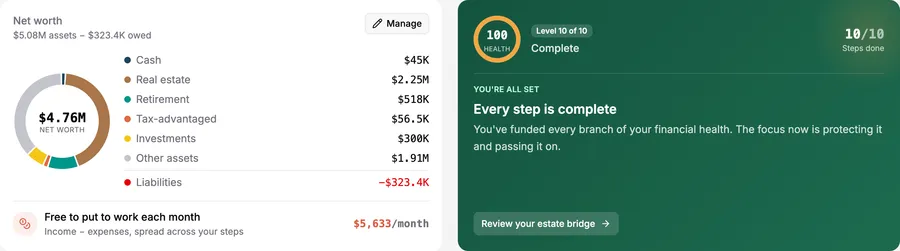
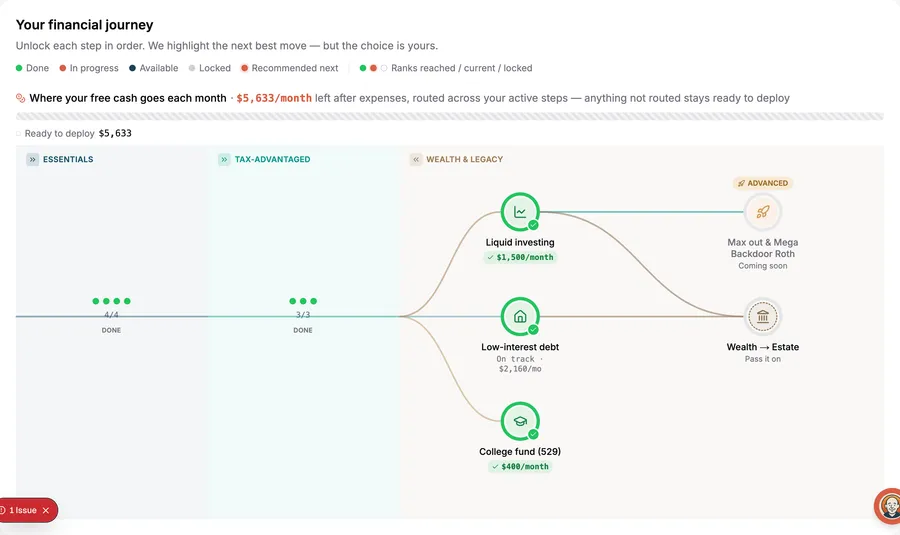
If you had a $20,000 emergency fund separate from retirement accounts, your family uses that first. The retirement accounts stay intact. The inheritance stays intact. This is why step 1 of the Money Roadmap is a liquid emergency fund, and it belongs on your personal asset map.
An emergency fund also protects against forced asset sales. If your heirs inherit a rental property or taxable investment account and need cash for unexpected costs, they may have to sell at the worst time—possibly triggering capital gains tax. A liquid cushion prevents panic selling.
The First Step: Start Now, Start Small
You do not need the full 6 months to get started. Open a high-yield savings account today (takes 10 minutes online), set up automatic transfers of $50 or $100 per paycheck, and watch it grow. Once you hit $1,000, you have already eliminated the most dangerous zone—the gap that forces new credit card debt.
Then follow the Money Roadmap: eliminate high-interest credit card debt, capture your full employer 401(k) match (it is free money), and build toward your full 3-6 month target. Each step protects the next.
An emergency fund is not glamorous. It earns you modest interest, not investment returns. But it is the one thing that keeps an unexpected job loss, illness, or repair from derailing your entire financial life—and your estate plan.
Sources
- 1.Best High-Yield Savings Accounts of June 2026 — Bankrate(opens in new tab)(bankrate.com)
- 2.Federal Reserve Report on the Economic Well-Being of U.S. Households in 2025(opens in new tab)(federalreserve.gov)
- 3.How Much Emergency Fund Should You Have — Fidelity(opens in new tab)(fidelity.com)
- 4.Cost of Living in New York City 2026 — RentCafe(opens in new tab)(rentcafe.com)
- 5.Treasury I-Bonds: Current Rates and Strategy — TreasuryDirect(opens in new tab)(treasurydirect.gov)
- 6.Emergency Fund Strategy 2026 — HeyGoTrade(opens in new tab)(heygotrade.com)
- 7.Bankrate's 2026 Emergency Savings Report(opens in new tab)(bankrate.com)