Account Guides
Your 529 Plan and Estate Planning: Name a Successor Owner, Superfund Gifts, and Avoid Probate
Learn how to name a 529 successor owner to skip probate, use superfunding for estate tax savings, and roll over unused funds to a Roth IRA without losing control.
A 529 plan is one of the few assets that generally sits outside your taxable estate—as a completed gift—yet stays under your control. Two separate things make that work: contributions are treated as completed gifts (with a timing exception if you superfund and die within five years), and naming a successor owner keeps the account out of probate. Here’s what you need to know about 529 successor owners, superfunding gifts, and the estate-planning edge a 529 can create.
How a 529 plan avoids probate with a successor owner
When you open a 529 college savings plan, you become the account owner and you can designate a successor owner—someone who takes over if you die or become unable to manage the account. If your plan accepts the successor you named, they generally take over without a court hearing or probate. The exact process depends on your specific 529 program’s rules, so record the successor in writing with your plan provider.
Without a successor owner, the 529 enters your probate estate. The court then decides who controls it, the account is tied up while your will is processed, and the account details become public record. For a family counting on education funds, this stall is costly.
A 529 is a rare asset: out of your estate, still in your control
Most assets that leave your taxable estate—like life insurance or retirement accounts—pass to a named beneficiary and you lose control. A 529 is different. As a completed gift, the contribution generally sits outside your taxable estate (the one catch: if you superfund and die within the five-year window, the post-death portion is pulled back in). Meanwhile, you still control how the money is invested, when distributions happen, and whether to change the beneficiary. Naming a successor owner is a separate step that keeps it out of probate—connect both to your will via your money-to-asset map.
Who can be a successor owner?
The successor owner does not have to be a spouse. Many parents name their spouse, but grandparents name an adult child or trusted friend. A successor owner must be at least 18 years old. You can also name a trust as successor owner, which lets your trustee (the person you choose) control distributions and ensure the funds are used as you intend—especially valuable if the beneficiary is young.
You can name the successor owner when you open the account or at any time afterward. You can change the successor owner as your family and circumstances change. Do it in writing with your plan provider so there is no ambiguity when the time comes.
Superfunding: a five-year gift that empties your taxable estate
“Superfunding” a 529 lets you contribute five years’ worth of gifts in a single year without triggering federal gift tax. In 2026, you can superfund up to $95,000 to one beneficiary (or $190,000 if you and your spouse both superfund).
Here’s how it works: the IRS allows an annual gift-tax exclusion of $19,000 per person per year (2026). Under section 529, you can elect to spread a single large contribution over five calendar years. So a $95,000 contribution counts as $19,000 for each of 2026, 2027, 2028, 2029, and 2030—no gift tax, no paperwork beyond filing IRS Form 709.
Why superfunding matters for your estate
Superfunding removes a large sum from your taxable estate without using any of your lifetime gift exemption. For a typical parent, this is straightforward: you contribute $95,000 today, the account grows tax-free, and the account (including its growth) generally stays outside your taxable estate—with the one timing exception noted next.
But there is a catch: if you die during the five-year election period, the IRS pulls back the unused portion of your gift. For example, if you superfunded $95,000 in 2026 and died in 2027, the portions allocated to 2028, 2029, and 2030 (roughly $57,000) are included in your gross estate for estate-tax purposes. The earnings on those funds, however, remain outside your estate. Discuss this timing with your estate attorney, especially if you are over 75 or have significant health concerns.
Filing Form 709 is mandatory for superfunding
Even if no gift tax is due, you must file IRS Form 709 (Gift Tax Return) in the year you superfund to elect the five-year averaging. Without this form, the IRS may treat the entire contribution as a gift in that single year, potentially triggering gift tax. File it and keep a copy with your tax records.
New York residents and the estate tax cliff
If you live in New York, superfunding is particularly powerful. New York has its own estate tax with a basic exclusion of $7,350,000 in 2026. Unlike federal law, New York does not allow portability (you cannot transfer your spouse’s unused exemption). And New York has a brutal cliff: if your estate exceeds about 105% of the exemption—roughly $7.7 million—you lose your entire exemption and the full value of your estate is subject to New York tax.
Superfunding a 529 moves assets out of your estate without using any lifetime exemption. It won’t rescue an estate that sits far over the cliff, but it can help when you are a modest amount over. For example, an estate around $7.85 million reduced by a $190,000 joint superfund lands near $7.66 million—just under the roughly $7.72 million cliff. A larger overage needs more than a single 529 gift. Consult a New York estate attorney to model your specific situation; learn more about the cliff itself.
529-to-Roth: a new path for unused education funds
Under the SECURE 2.0 Act, a new path opened in 2024: an adult beneficiary can roll unused funds from a 529 directly into their own Roth IRA, tax-free. This is especially valuable if a child does not attend college, attends on a scholarship, or uses 529 funds early and has excess remaining.
The 529-to-Roth rollover rules
To qualify for a 529-to-Roth rollover:
- The 529 account must have been open for at least 15 years.
- The beneficiary of the 529 and the owner of the Roth IRA must be the same person.
- The beneficiary must have earned income equal to (or greater than) the rollover amount in the year of the rollover.
- Rollovers are subject to annual Roth IRA contribution limits. In 2026, an individual under 50 can roll over a maximum of $7,500; an individual 50 or older can roll over $8,600.
- The lifetime rollover cap is $35,000 per beneficiary across all 529 accounts.
Why this matters for your plan
A typical story: a grandparent opens a 529 for a grandchild in 2010, contributes $20,000, and the account grows to $35,000. The grandchild earns a full scholarship and does not need the education funds. Starting in 2025 (15 years later), the grandchild can roll $7,500 into a Roth IRA tax-free. Over five years, all $35,000 can move into the Roth, growing tax-free forever, with no income-limit restrictions that normally apply to Roth contributions.
This flexibility means a 529 is no longer a “lose it or use it” vehicle. Unused funds can become retirement savings. Build this into your plan if you are funding a 529 for a child or grandchild, especially if education costs are uncertain (scholarships, trade school, choosing not to attend college).
Connecting your 529 to your will and estate plan
A 529 is only truly “in your plan” if it is coordinated with your will and your money-to-asset map. Here is the checklist:
- Name a successor owner. Do not skip this. Write it down with your plan provider.
- Name a beneficiary. The beneficiary is the student; the owner is you (or a trust). Do not confuse the two.
- Update your will. Your will should reference the 529 and state who has authority over it if both you and your successor owner die. Name a backup successor.
- File Form 709 if you superfund. Keep a copy with your tax return and your will.
- Tell your estate executor. Make a list of all your 529 accounts (account numbers, custodian, successor owner, beneficiary) and give it to your executor or estate attorney. A 529 discovered after probate can cause complications.
- Review annually. As your family grows or circumstances change, revisit the beneficiary. You can change the beneficiary to another family member penalty-free. You can also change your successor owner if your first choice is no longer appropriate.
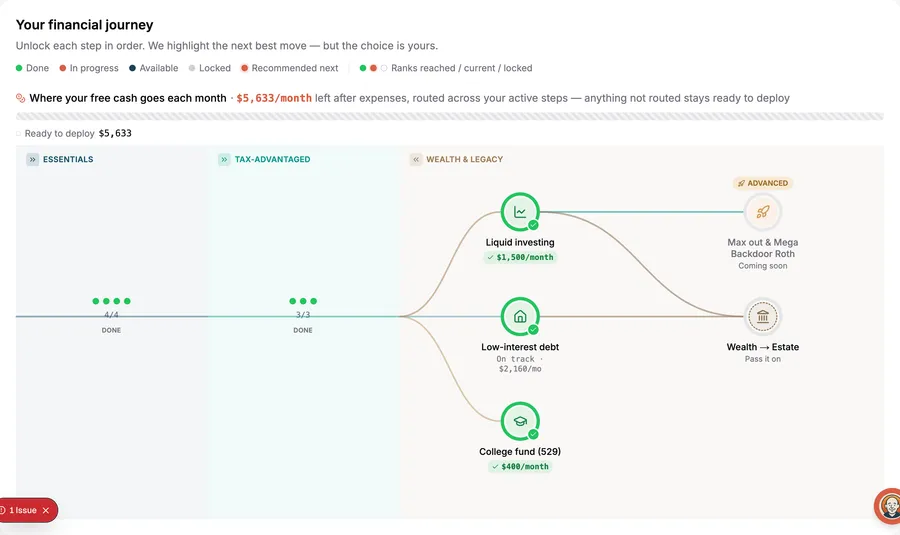
The Money Roadmap at Sunset walks you through this coordination. A 529 is a powerful tool for education savings and estate tax reduction, but it only works if it is named correctly and connected to the rest of your financial plan.
From college savings to legacy
A 529 plan is one of the few ways to move significant wealth out of your taxable estate, grow it tax-free, and stay in control—all while earmarking it for education or, via the new Roth rollover, for your heir’s retirement. Name a successor owner, consider superfunding if it makes sense, and connect it to your will.
Sunset helps you coordinate these pieces. The Money Roadmap guides you through every account and asset; then your estate plan ensures it all flows as you intend.
Sources
- 1.IRS Topic 313: Qualified Tuition Programs (QTPs)(opens in new tab)(irs.gov)
- 2.Choosing a Successor Account Owner(opens in new tab)(savingforcollege.com)
- 3.Understanding 529 Rollovers to a Roth IRA(opens in new tab)(fidelity.com)
- 4.10 Rules for Superfunding a 529 Plan in 2026(opens in new tab)(savingforcollege.com)
- 5.What Happens to a 529 Plan if the Account Owner Dies?(opens in new tab)(thecollegeinvestor.com)
- 6.529 Plans and Estate Planning: What You Need to Know(opens in new tab)(hurleyburish.com)
- 7.New York Estate Tax: Exemption and the Cliff(opens in new tab)(brevy.com)
- 8.529 Contribution Limits 2026(opens in new tab)(fidelity.com)