Wealth & Will
Transfer-on-Death (TOD) and Payable-on-Death (POD) Accounts: Skip Probate on Your Cash and Brokerage
POD and TOD accounts let your cash and brokerage skip probate without a trust. Learn how to set them up, what they won't protect, and why your will still matters.
When you die, does your savings account go through probate, or does your brokerage account go straight to your kids? The answer depends on whether you’ve named a beneficiary on each account. Payable-on-Death (POD) and Transfer-on-Death (TOD) accounts let your cash and investments skip probate entirely—passing straight to the person you name, with no court involvement and no legal fees.
But these accounts are not a complete estate plan. They don’t prevent estate taxes, don’t stop creditors from claiming against your estate, and they override your will entirely. Understanding when to use them—and when you still need a will or trust—is the difference between a smooth transition and an accidental disinheritance.
What’s the difference between POD and TOD accounts?
POD and TOD are the same mechanism applied to different account types. Both let you name a beneficiary who receives the account balance when you die, without probate.
POD (Payable-on-Death) accounts are for bank assets:
- Checking and savings accounts
- Certificates of deposit (CDs)
- Money market accounts
- Savings bonds
TOD (Transfer-on-Death) accounts are for investment accounts:
- Brokerage accounts (stocks, bonds, mutual funds)
- Certain taxable individual accounts
- In some states, vehicles or real estate (via TOD deeds)
The mechanics are identical. During your lifetime, you keep full control: you earn interest, you buy and sell investments, you can spend the money, and you can change or cancel the beneficiary anytime without notifying them. When you die, ownership transfers directly to the named beneficiary. The financial institution hands over the balance; probate never touches it.
How to set up a POD or TOD account
Setting up either account is free and takes minutes.
For POD accounts (bank accounts):
Visit your bank’s website or go to a branch in person. Most major banks—Chase, Bank of America, Wells Fargo, PNC—offer POD designations online or through a simple form. You’ll provide your beneficiary’s full legal name, date of birth, and Social Security number. If you’re adding multiple beneficiaries, you can usually specify how the money is split (equal shares, or a percentage you choose). The bank files the designation; there are no attorney fees, no filing fees, no ongoing costs.
For TOD accounts (brokerage accounts):
Contact your brokerage firm (Fidelity, Vanguard, Charles Schwab, Interactive Brokers, etc.) and ask for a TOD registration form or update to your account. Provide your beneficiary’s legal name, date of birth, and SSN. Some brokers allow you to do this online; others require a printed and signed form mailed back to them. Again, there’s no cost, and you can revoke or change it anytime.
You can change your beneficiary or cancel the POD/TOD status at any time during your life, without notifying the beneficiary. Simply contact the financial institution and submit a new form.
Update your designations after major life events
If you marry, divorce, have a child, or experience a major change in family circumstances, review all your POD and TOD beneficiary designations immediately. An outdated designation can lead to unintended consequences—for example, a late ex-spouse receiving an account you meant for your new family. Use the complete checklist for updating beneficiaries after life changes to stay aligned.
POD and TOD accounts skip probate, but not estate tax
This is the critical distinction that catches many people off guard. Probate is a legal process—a court oversees the transfer of assets listed in your will. Estate tax is a tax—the IRS and your state government tax the total value of everything you own when you die.
POD and TOD accounts bypass probate. Your beneficiary gets the money without waiting months for a will to be admitted to probate court, without filing a petition, without paying court fees or executor fees. The account simply changes hands.
But POD and TOD accounts do NOT bypass estate tax. The account balance is still counted in your taxable estate. For 2026, the federal exemption is $15,000,000 per person, so most U.S. estates owe no federal tax. New York’s exemption, however, is only $7,350,000—and it has a dangerous cliff. Between the exemption and about $7.72 million (105% of the exemption), the exemption phases out; once the estate tops about $7.72 million, it disappears entirely and the whole estate is taxable from dollar one.
This matters because POD and TOD balances are counted in your taxable estate even though they skip probate. A $7.5 million savings account with a POD beneficiary, for instance, still counts toward that total—putting you in the phase-out zone (and over the full cliff if your other assets push the estate above about $7.72 million). Learn how the New York estate tax cliff works and why estates near the threshold need careful planning in New York.
POD and TOD accounts are non-probate transfers—and they override your will
Your will controls probate assets. POD and TOD accounts, life insurance, retirement accounts, and other beneficiary designations are non-probate assets. A beneficiary designation on a TOD account is a legal contract with the financial institution; it takes precedence over your will. If your will says your sister gets the brokerage account but the TOD form names your brother, your brother wins—full stop. See how beneficiary designations and wills interact, and coordinate all your designations to avoid accidental disinheritance.
Who actually gets the money—and what stops them?
When the beneficiary dies (and you’ve named a successor beneficiary, or a contingent), the money goes to that person. But the estate still has obligations: debts, taxes, administration costs.
Generally, creditors and the estate claim against the probate estate first. If there are not enough probate assets to cover debts or taxes, some states have limited mechanisms to reach POD and TOD accounts—through statutory contribution provisions or fraudulent-transfer doctrines—but protections vary widely by jurisdiction. Check with a local estate attorney about your state’s rules.
The bottom line: POD and TOD accounts are not shielded from creditor claims in all jurisdictions. If your estate has significant debts, unpaid taxes, or ongoing liabilities, a POD account at your bank won’t protect your beneficiary from a judgment. This is another reason to pair POD and TOD accounts with a complete will or trust that addresses debts and tax liability.
When to use POD and TOD accounts
POD and TOD accounts are efficient for straightforward situations:
- Single, smaller estates. If you have under $1 million in liquid assets and one or two clear beneficiaries, POD and TOD accounts can handle most of your cash and investments.
- Supplementing a will or trust. Use TOD on your brokerage account and POD on your bank account to keep liquid cash out of probate, while your will or trust handles real estate and other complex assets.
- Quick, low-cost setup. POD and TOD accounts cost nothing, involve no attorney, and bypass probate delays. For straightforward transfers, they’re the fastest path.
- Flexibility. You can change your beneficiary anytime, unlike a revocable trust, which requires amendment or restatement.
POD and TOD accounts are not a complete solution if:
- Your estate is large or complex. If you own real estate, a business, or have multiple heirs with conflicting interests, you need a trust or a detailed will that addresses succession, minimizes taxes, and prevents disputes.
- You want to avoid the New York estate tax cliff. POD and TOD accounts don’t help; you need sophisticated tax planning and possibly a trust structure that’s beyond the scope of a simple beneficiary designation.
- You want to name a guardian for minor children. Only a will can appoint a guardian; POD and TOD accounts have no provision for that.
- You want to control how and when heirs receive money. A revocable trust lets you specify that your child’s inheritance be held in trust until age 30, or that distributions go to a spouse only for life and then to children. POD and TOD accounts hand over the full balance immediately.
- You suspect a beneficiary might face creditor or Medicaid problems. If your beneficiary is judgment-proof or on means-tested benefits, receiving a lump sum from a POD account could jeopardize those benefits. A trust with careful drafting can prevent this; a POD account cannot.
POD and TOD accounts need a coordinating will
Here’s the mistake most people make: they set up a POD account on their bank savings account, name their son as beneficiary, and assume the rest of their estate is “taken care of.” But what about the house? What about personal property—the car, the jewelry, the family photos? What about any assets without a beneficiary designation? What about the minor grandchildren?
All of those things go through probate if they’re not covered by a will, trust, or beneficiary designation.
Your will needs to exist alongside your POD and TOD accounts. At minimum, your will should:
- Name an executor to oversee the estate administration
- State who gets assets without beneficiary designations
- Name a guardian for minor children
- Address debts, taxes, and administration expenses
- Ensure all your beneficiary designations (POD, TOD, life insurance, retirement accounts) are coordinated so nobody gets accidentally disinherited
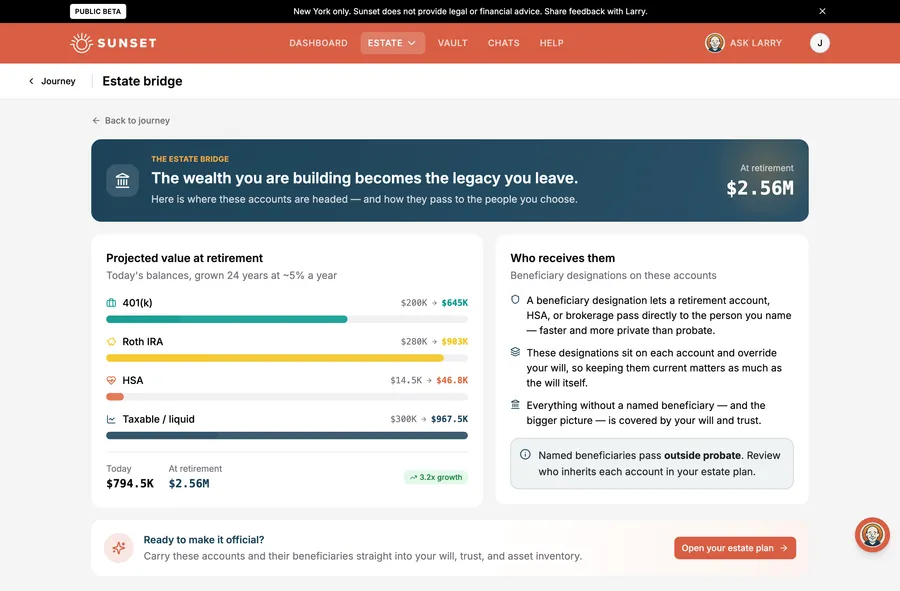
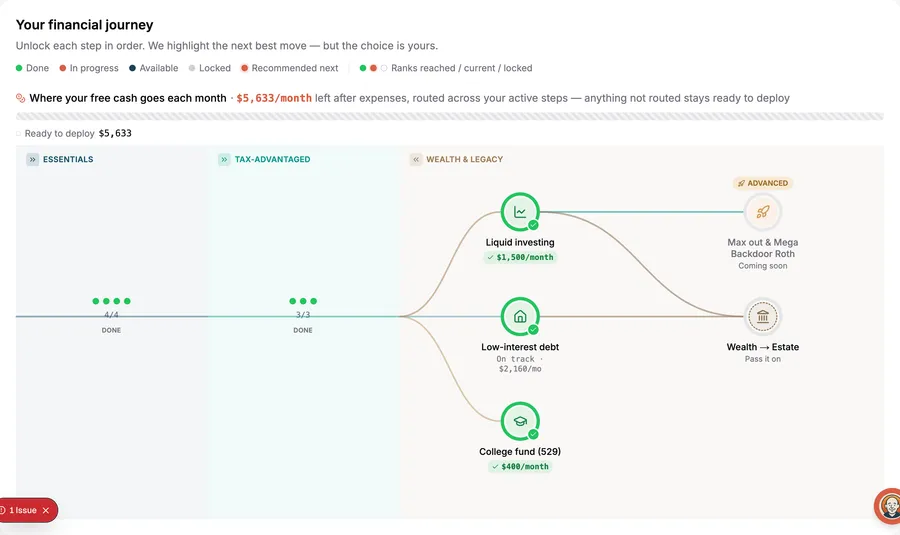
See exactly which assets pass by contract versus through your will. This is the map Sunset users create in the Money Roadmap: every dollar, every account, and exactly where it goes when you die.
Verify TOD is available in your state
Not all states recognize TOD designations for brokerage accounts. TOD deeds for real estate are available in most states, but not all. Before relying on a TOD deed for your home, confirm it’s permitted in your state and consult a local real estate attorney. POD accounts for bank deposits are widely available, but always ask your bank to confirm.
Your POD and TOD accounts in context
POD and TOD accounts are one piece of the larger estate-planning picture. They’re excellent for keeping liquid cash and investments out of probate, which saves time and money for your heirs. But they don’t eliminate estate tax, they don’t prevent creditor claims in all cases, and they can accidentally override your will if you’re not careful.
The real power comes from seeing all your assets together: your emergency fund, your retirement accounts (which have their own beneficiary rules), your 401(k), your Roth IRA, your life insurance, your brokerage account, your real estate, and any business interests. Use the Money Roadmap to map where everything goes. Then coordinate your beneficiary designations, TOD forms, POD designations, will, and trust so they all point in the same direction.
That’s when probate avoidance, tax efficiency, and peace of mind align.
Sources
- 1.Transfer on Death Accounts vs. Payable on Death Accounts - SmartAsset(smartasset.com)
- 2.Pitfalls of Pay on Death (POD) Accounts | ACTEC(actec.org)
- 3.FINRA - Plan Ahead to Transfer Your Brokerage Account Assets on Death(finra.org)
- 4.NY Estate Tax 2026: Exemption and the Cliff - Brevy Care(brevy.com)
- 5.Does a Transfer on Death (TOD) Override a Will? - Realized(realized1031.com)
- 6.A Creditor's Ability to Reach Non-Probate Assets - Keystone Law(keystone-law.com)
- 7.New York Estate Tax Department - NY.Gov(tax.ny.gov)
- 8.Transfer on Death Designation: 2026 Account Guide - Alpha Excapital(alphaexcapital.com)